
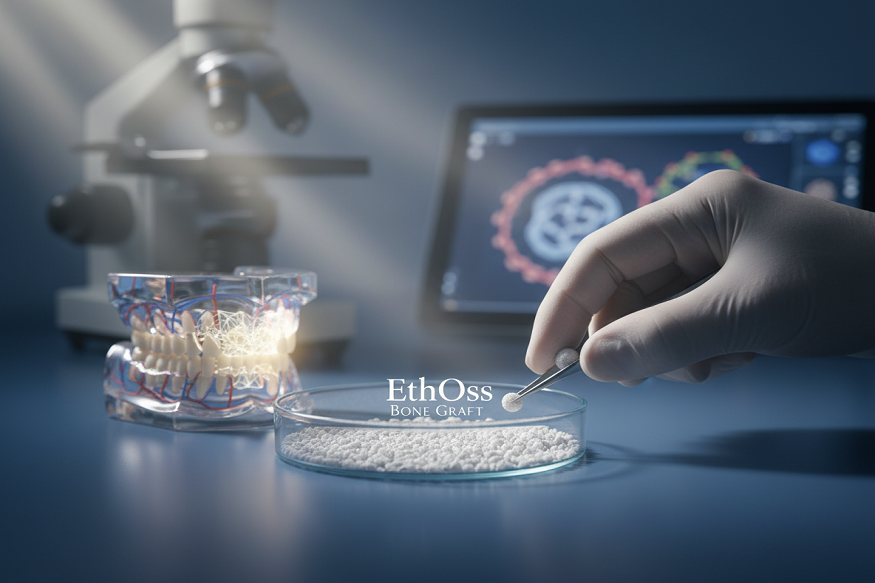
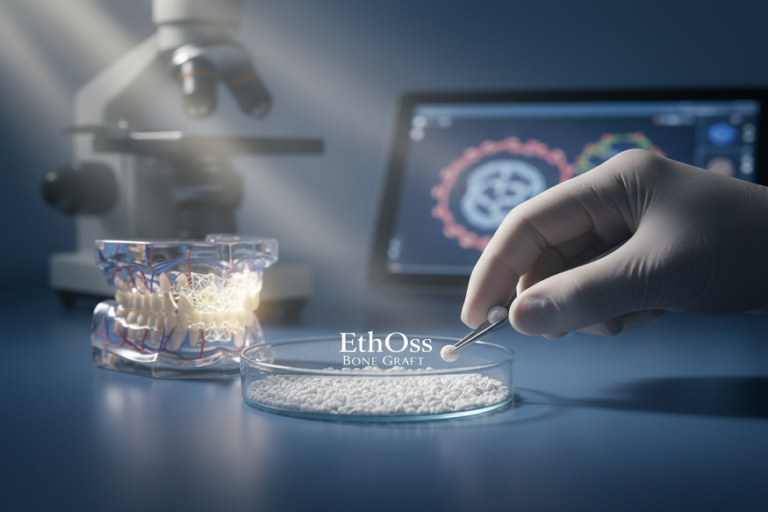
In the world of regenerative dentistry, simplicity is not just a convenience. It is a clinical advantage. Every additional step in a procedure adds time, complexity, and potential points of failure. That is why the development of EthOss has been such a significant shift for clinicians performing guided bone regeneration. This is not just another bone graft material. It is a complete system — a synthetic bone graft putty that combines osteoconductive structure with an integrated barrier function, eliminating the need for a separate collagen membrane altogether.
For years, the standard of care in GBR has been to place a bone graft, then cover it with a collagen membrane to protect the site from soft tissue ingress. It works, but it requires additional materials, additional cost, and additional surgical time. EthOss changes that equation. With its unique composition of 65% Beta Tricalcium Phosphate and 35% Calcium Sulphate, it creates what clinicians describe as an “integrated membrane” a self-contained cell-occlusive barrier that performs the same function as a traditional collagen membrane, but from within the graft itself.
The Science Behind the Integrated Barrier
The key to understanding how EthOss removes the need for a collagen membrane lies in the behaviour of calcium sulphate. When EthOss is placed into a surgical site, the calcium sulphate component sets in situ. This is not just a minor chemical reaction. It is the foundation of the entire system. As it sets, it forms a tightly controlled, cell-occlusive binder that is porous enough to allow neo-vascularisation but not porous enough to allow soft tissue cells to migrate into the graft.
Read More: 5 Reasons to Choose a Local Dentist in Burlington for Your Oral Health Needs
This is precisely what a collagen membrane does — it creates a physical barrier that prevents faster-growing soft tissue from invading the slower-growing bone graft. But instead of being a separate layer placed on top, this barrier is built directly into the graft material. The calcium sulphate binds the beta TCP particles together, creating a stable, semi-rigid structure that resists particle migration and maintains its shape throughout the healing process.
The result is a bone graft putty that is both osteoconductive and self-protecting. The beta TCP provides the scaffold for new bone growth, while the calcium sulphate creates the barrier that protects that growth. Together, they form a complete system that does not require additional membranes.
Clinical Benefits of Removing the Membrane
The decision to remove the collagen membrane from the GBR protocol is not just about convenience. It has real clinical implications that affect both the surgeon and the patient.
Simplified Surgical Technique
Without the need to place a membrane, the surgical procedure becomes simpler. There is no membrane to trim, position, or secure. There is no risk of membrane exposure or premature degradation. The graft is placed, it sets, and it protects itself. This simplicity reduces surgical time and lowers the learning curve for clinicians new to GBR procedures.
Reduced Material Costs
Collagen membranes are expensive. Removing them from the protocol reduces the overall cost of the procedure without compromising outcomes. For practices managing budgets, this is a meaningful advantage.
Improved Healing Environment
One of the less obvious benefits of removing the membrane is that it allows the periosteum and its blood supply to have direct access to the graft site from day one. With a traditional membrane in place, the periosteum is separated from the graft. With EthOss, the barrier is integrated, so the periosteum can remain in contact with the surgical site, promoting better vascularisation and faster healing.
Stability and Particle Control
The set calcium sulphate creates a stable graft that resists particle migration. This is particularly important in applications like socket preservation or buccal defects, where graft stability is critical for success. The material holds its shape, maintaining the contours needed for optimal bone regeneration.
How EthOss Compares to Traditional Bone Graft Putty
Not all bone graft putties are created equal. Some are simply granular materials mixed with a binder to improve handling. Others, like EthOss, are engineered systems designed from the ground up to optimise healing.
Traditional bone graft putty may offer improved handling compared to granules, but it typically still requires a membrane for protection. EthOss is different. Its integrated barrier means it can be used as a standalone solution for many GBR applications, including periodontal defects, sinus lifts, extraction sockets, and ridge augmentation.
The material is also fully synthetic, containing no human or animal components. This eliminates concerns about disease transmission or immunological reactions, and it aligns with the growing patient preference for synthetic, ethically sourced materials.
Real-World Applications and Outcomes
The proof of any regenerative material lies in its clinical performance. EthOss has been extensively studied and used in practice, with outcomes that support its design principles.
In extraction socket preservation, EthOss has been shown to maintain ridge dimensions while promoting new bone formation. The material resorbs over 6 to 12 months, being completely replaced by host bone. Biopsies taken at 12 weeks typically show around 50% new bone formation, demonstrating that the material is not just filling space but actively supporting regeneration.
In sinus lift procedures, the stability of the set graft is critical. EthOss provides this stability while allowing the periosteum to remain in contact with the graft site, promoting vascularisation from the earliest stages of healing.
For periodontal defects and buccal plate augmentation, the combination of ease of application and integrated barrier function makes EthOss a practical choice. The material can be delivered directly from a syringe, shaped to fit the defect, and left to set without the need for additional fixation or coverage.
The Emotional Side of Choosing the Right Material
For clinicians, choosing a bone graft material is not just a technical decision. It is a commitment to patient care. Every material you use becomes part of your patient’s healing journey. When you choose a system that simplifies the procedure, reduces costs, and improves outcomes, you are not just making a clinical choice. You are making a promise — that you will use the best tools available to give your patients the best possible results.
There is a quiet satisfaction in knowing that the material you placed will protect itself, that the barrier function is built in, that the graft will resorb and be replaced by the patient’s own bone. It is a confidence that comes from understanding the science, trusting the evidence, and seeing the results in your own practice.
For patients, the benefits are equally meaningful. A simpler procedure means less time in the chair. A synthetic material means no concerns about animal or human-derived components. A stable graft means better healing and more predictable outcomes. These are not abstract advantages. They are real improvements to the patient experience.
Why EthOss Represents the Future of Bone Regeneration
The development of EthOss is not just an incremental improvement. It is a rethinking of how bone regeneration should work. By combining the osteoconductive properties of beta TCP with the barrier function of calcium sulphate, it creates a system that is greater than the sum of its parts.
This integrated approach is the future of regenerative dentistry. It is a move away from complex, multi-component systems toward simpler, more elegant solutions that work with the body’s natural healing processes rather than trying to control them with external barriers.
Read More: Benefits of Opting for Private Dental Care in Manchester
For clinicians looking to optimise their GBR procedures, EthOss offers a compelling alternative. It is synthetic, it is stable, it is self-protecting, and it is supported by clinical evidence. Most importantly, it removes a step from the procedure without compromising outcomes — a rare achievement in a field where every variable matters.
Ready to Rethink Your GBR Protocol?
The question is no longer whether a collagen membrane is necessary. The question is whether you need the complexity, cost, and potential complications that come with it. EthOss has shown that the answer is often no.
For practices performing guided bone regeneration, this is an opportunity to simplify, to improve outcomes, and to give patients a better experience. It is a chance to use a material that is not just a graft, but a complete system designed for true host bone regeneration.
The future of bone regeneration is integrated. It is synthetic. It is simple. And it is here now.





+ There are no comments
Add yours